8mm, Hi8 & Video 8 Digitizing in London, Ontario
These small camcorder tapes hold a decade of family footage — and they're more fragile than they look.
500+ tapes digitized since 2019 · Near Oxford & Wonderland, London ON
What Does a Hi8 or Video 8 Tape Look Like?
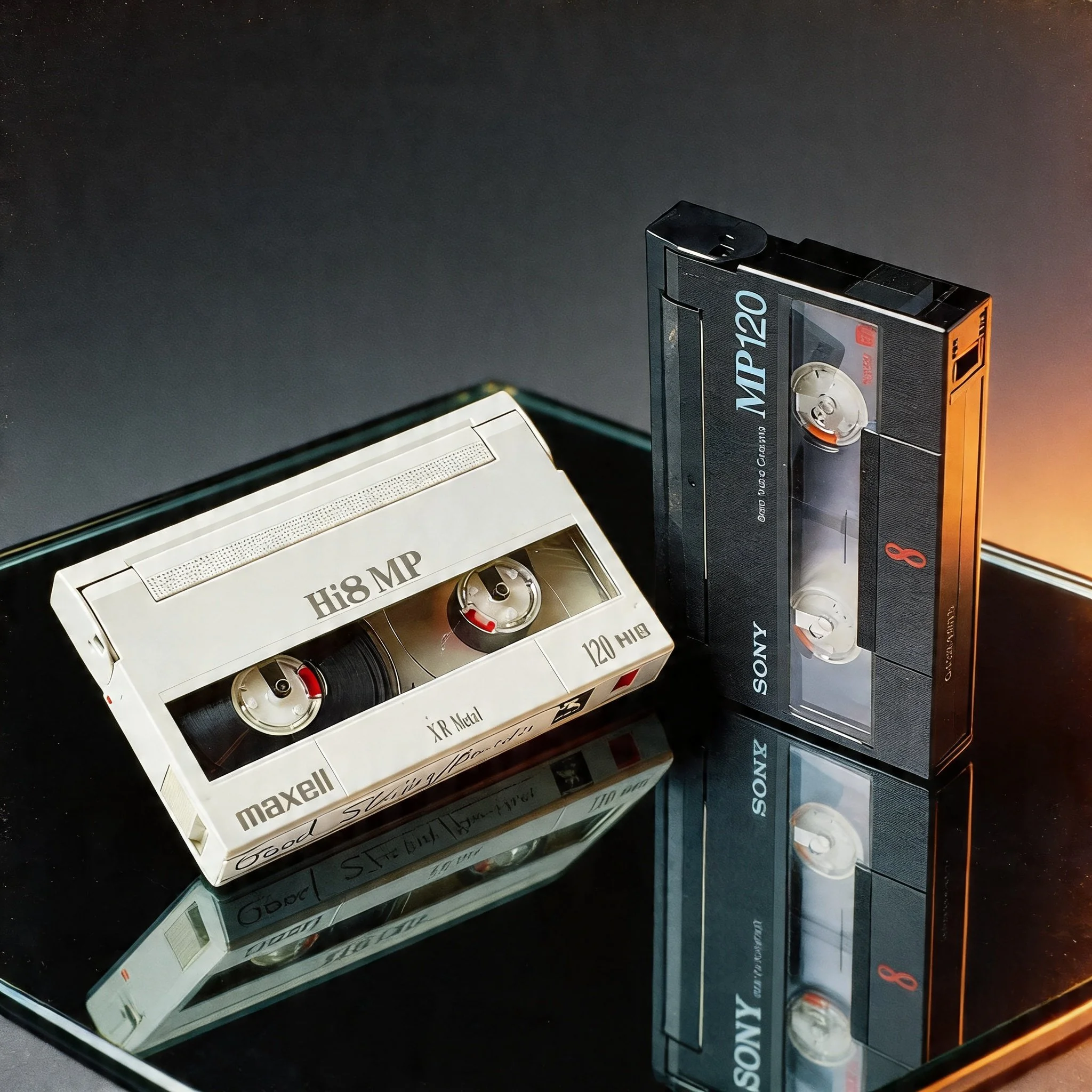
Hi8 and Video 8 tapes use the same small cassette shell — about 95mm × 62mm × 15mm, roughly the size of a large audio cassette. They're smaller than VHS-C and have a distinctly different shape: more square, with a sliding plastic door or shutter along the bottom edge that protects the tape opening.
Look for "Hi8," "Video 8," or "8mm" printed on the label. Hi8 tapes often have a gold or silver colour scheme; Sony's Hi8 line in particular uses a black-and-gold design that's easy to recognize. Video 8 tapes tend to be plainer in appearance.
Common brands: Sony (by far the most common), TDK, Fuji, Maxell, and BASF. Sony dominated the 8mm camcorder market, so most tapes you'll find are Sony.
Standard play times are typically 90 or 120 minutes, depending on the tape length — P5-90 (90 min) and P6-120 (120 min) are the most common designations.
A note on Digital8: Some Sony camcorders from the late 1990s and early 2000s used the same 8mm cassette shell to record a digital signal — this format is called Digital8. The tape looks identical from the outside. We handle Digital8 as well; just mention it if you know, and we'll confirm during playback.
The Moments People Find on Hi8 & Video 8 Tapes
Hi8 and Video 8 were the dominant camcorder formats from the late 1980s through the 1990s. If your family had a camcorder during that decade, there's a very good chance these are the tapes.
First steps, first words, and early childhood years
Birthday parties and backyard get-togethers
Weddings, anniversaries, and family milestones
School plays, sports games, and dance recitals
Summer vacations and holiday gatherings
Home movies of people who are no longer here
Footage of houses, neighbourhoods, and everyday life that no longer exists
These tapes span an era — the late '80s through the early 2000s — when a lot of families were capturing home life for the first time. Much of what's on them has never been watched since it was recorded.
Hi8 Tape Is Thinner Than You Think
Hi8 and Video 8 use the same magnetic tape technology as VHS: a layer of metal oxide bonded to a plastic backing with a chemical binder, travelling over a helical-scan play-record drum. Over time, the binder breaks down. The oxide sheds. The signal weakens.
But 8mm tape is significantly thinner and narrower than VHS tape. What that means in practice: the margin for error is smaller. A small amount of oxide shedding that a VHS tape might tolerate shows up as visible dropout on Hi8 — white speckles, horizontal streaks, or sections where the picture simply drops out. Physical creases or folds that might be survivable on a thicker tape can be fatal on 8mm.
Storage conditions matter more here than on larger formats. A Hi8 tape that spent years in a damp basement or a hot garage has likely fared worse than a VHS tape stored under the same conditions. The smaller tape pack also means that uneven winding tension — from a pause mid-tape, a stuck mechanism, or an old camcorder with a worn transport — can create tight spots that cause physical stress during playback.
Then there's the camcorder problem. Hi8 and Video 8 camcorders are thirty to forty years old. The playback heads on these machines are small and precise, and a worn or dirty head on an aging camcorder can chew through fragile tape rather than read it.
When they break, they’re a pain to fix — but they’re worth fixing.
Straightforward pricing. No surprises at pickup.
$50 per tape covers up to 2 hours of content, with a USB stick included. Most Hi8 and Video 8 tapes run 90-120 minutes at standard play — within the base rate. If a tape was recorded at long play and runs longer, we confirm any overage before proceeding.
| Tapes | Discount |
|---|---|
| 1–9 tapes | Standard rate |
| 10–19 tapes | 10% off |
| 20+ tapes | 15% off |
Discounts apply to the base rate. Overage charges are separate.
What happens to your tapes.
Step 1: Drop off your tapes Book a slot online. You'll get a confirmation with the drop-off address near Oxford & Wonderland. No shipping — everything stays local.
Step 2: We digitize by hand Each tape is played back in real time on calibrated equipment. There's no batch processing — your tapes are handled individually and inspected before and after transfer.
Step 3: Pick up your files Your digitized video is delivered on a USB stick (included in the price). Video files are MP4 — playable on any modern device. Cloud delivery via Dropbox is available on request.
Common questions about 8mmtapes.
-
Video 8 was the original 8mm camcorder format, introduced in 1985. Hi8 came along in 1989 with better picture quality — sharper resolution, less noise. Digital8 arrived in the late 1990s and recorded a digital DV signal onto the same cassette shell. All three use a physically identical or very similar tape. For digitizing purposes, it matters in terms of equipment and output quality, but not in terms of what you need to do — just drop off the tapes and we'll identify the format during playback.
-
It depends on the extent of the damage. Light dropout — scattered speckles, brief horizontal lines — is common in older Hi8 tapes and doesn't necessarily mean the core content is lost. Severe dropout throughout suggests significant oxide shedding, and some of that damage may be permanent. The only way to assess it accurately is to play the tape on properly maintained equipment. We'll give you an honest read on what we get.
-
Yes. Bring them together and we'll sort them out. If you can identify which are which, that's helpful — but if the labels are worn or missing, we'll confirm the format during playback. Pricing is the same for both.
-
No — Hi8 and Video 8 require a dedicated 8mm playback deck or camcorder. They are not compatible with VHS players, VHS-C adapters, or any other consumer format. If your Hi8 camcorder is broken or gone, there's no consumer workaround. That's one of the reasons getting these digitized matters.
Booking takes 2 minutes.
Your tapes are waiting.
Questions first? Call or text (226) 378-4695 · cygnalsmultimedia@gmail.com