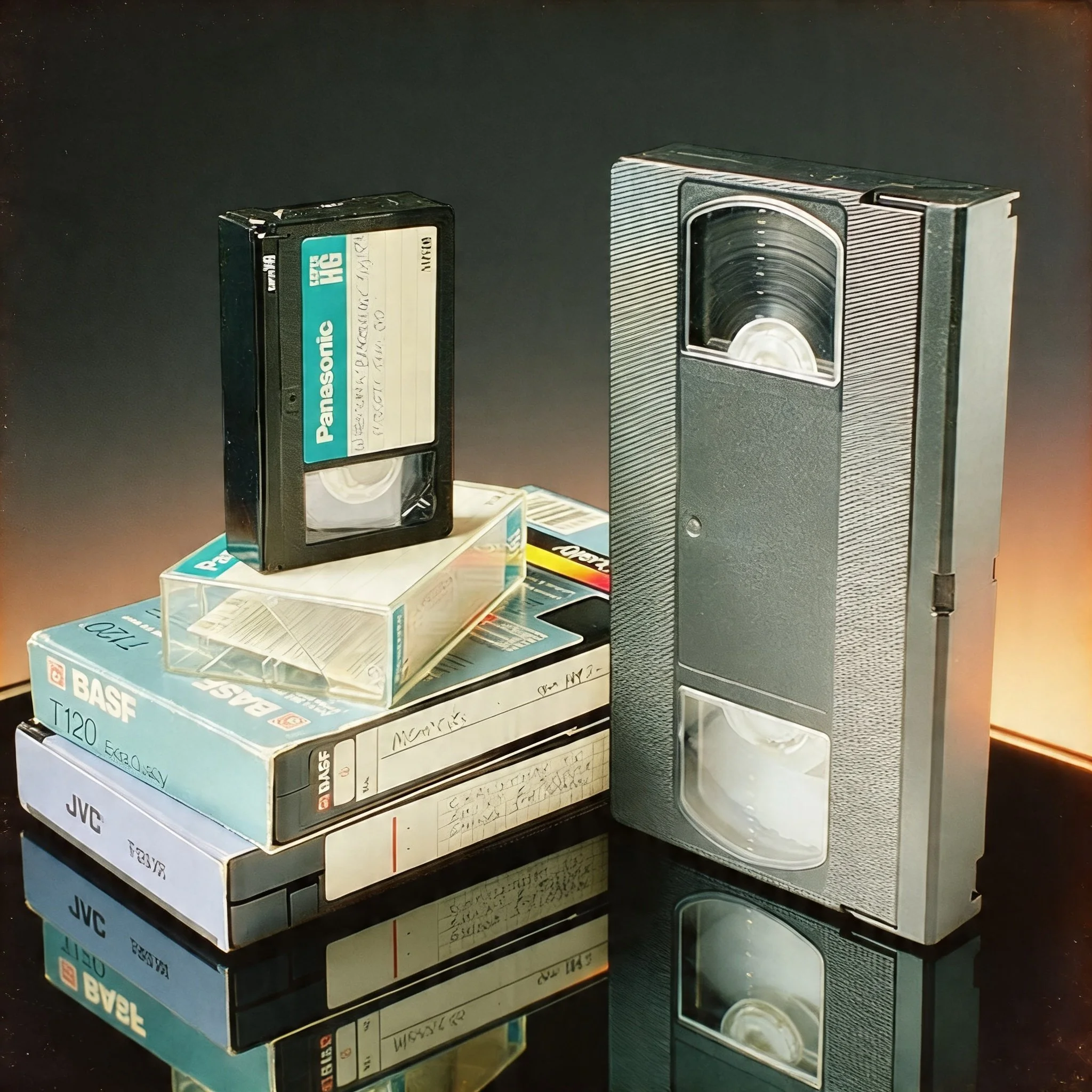
VHS Digitizing in London, Ontario
VHS tapes don't last forever. The magnetic signal on a tape from the '80s or '90s is already weakening — whether the tape has been played or not. We convert your VHS tapes to digital files before that signal is gone for good. Local drop-off, $50 per tape, 7–10 day turnaround.
500+ tapes digitized since 2019 · Near Oxford & Wonderland, London ON
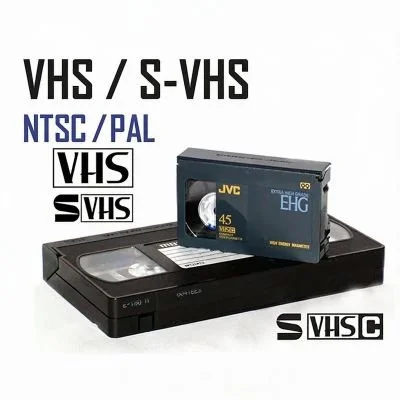
What a VHS tape looks like.
VHS is the large, rectangular black or grey cassette most people picture when they think of a VCR. It has two spools of 1/2” magnetic tape visible through a small clear window near the bottom, and a hinged flap at the front that opens when the tape is inserted into a VCR.
Common brands include JVC, BASF, Fuji, Maxell, Sony, TDK, and Scotch. The tape length is usually printed on the label — T-120 is the most common, which holds up to 2 hours at standard recording speed (or up to 6 hours if recorded at extended play).
If the cassette is smaller than a paperback book but larger than a deck of cards, you may have a VHS-C — the compact version used in portable camcorders.
The moments people find on VHS.
Most VHS tapes in storage were recorded by families, not broadcasters. What's on them tends to be irreplaceable:
Christmas mornings and holiday gatherings
Birthday parties and first steps
Weddings and anniversaries
School plays, dance recitals, and sports events
Graduations
Home movies of people who are no longer here
Some tapes are TV recordings — movies or shows recorded off-air — but the ones that matter most are the ones no one else has a copy of.
VHS tape doesn't wait.
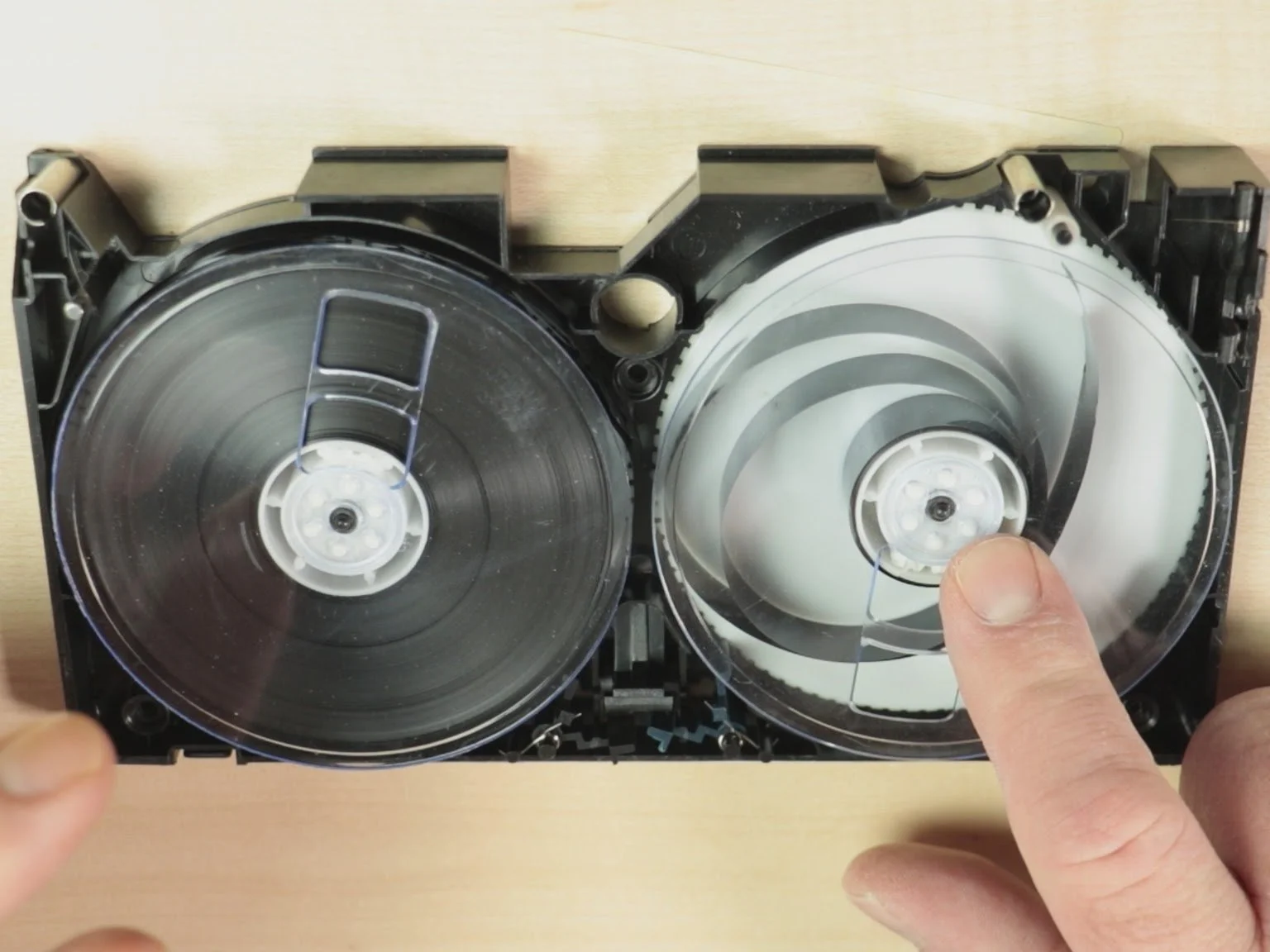
The magnetic oxide layer that holds your video signal is bonded to a plastic backing with a chemical binder. Over time — regardless of storage conditions — that binder breaks down. The oxide flakes off. The signal weakens and, eventually, disappears.
A tape that's been sitting in a cool, dry closet is in better shape than one that spent years in a basement or garage. But even well-stored tapes from the 1980s and early 1990s are 30 to 40 years old. Many are already showing symptoms: faded colour, horizontal lines through the picture, audio dropout, or the dreaded squeal of oxide shredding against the playback head.
Playing a degraded tape without proper equipment can accelerate the damage — or destroy it entirely.
The window for recovery is open. But it won't stay open.
Straightforward pricing. No surprises at pickup.
$50 per tape Covers up to 2 hours of content. USB stick included.
+$20 per additional hour Many T-120 tapes were recorded in LP or EP mode and run 4–6 hours. If your tape is one of them, we'll confirm the overage before we proceed. You're never surprised at pickup.
| Tapes | Discount |
|---|---|
| 1–9 tapes | Standard rate |
| 10–19 tapes | 10% off |
| 20+ tapes | 15% off |
Discounts apply to the base rate. Overage charges are separate.
What happens to your tapes.
Step 1 Drop off your tapes Book a slot online. You'll get a confirmation with the drop-off address near Oxford & Wonderland. No shipping — everything stays local.
Step 2 We digitize by hand Each tape is played back in real time on calibrated equipment. There's no batch processing — your tapes are handled individually and inspected before and after transfer.
Step 3 Pick up your files Your digitized video is delivered on a USB stick (included in the price). Video files are MP4 — playable on any modern device. Cloud delivery via Dropbox is available on request.
VHS questions we hear often.
-
The base price of $50 covers the first 2 hours. If a tape runs longer — which is common with T-120s recorded at LP or EP speed — we'll time it during digitizing and let you know the exact overage before you're charged. A 6-hour tape would be $50 base + $80 overage = $130. Most people find it's still worth it.
-
Yes, in most cases, if you’re okay sacrificing the VCR. A stuck tape usually means the VCR mechanism failed mid-eject. We are not VCR technicians, just preservation evangelists. The VCR might end up wrecked, but odds the tape will be saved.
-
Possibly, but mold requires special handling. A moldy tape played in a standard VCR can destroy the playback heads and spread contamination to other tapes. Contact us before bringing in anything you suspect has mold — we'll tell you what we can do.
-
Probably not, but the sooner the better. The majority of tapes we see from the '80s and '90s are still recoverable. Some have significant quality loss; some look remarkably good. The only way to know is to play it back on proper equipment. We'll tell you honestly what we get.
VHS tapes from the '80s and '90s are at the point where every year matters. Booking takes 2 minutes.
Don't wait on this one.
Questions first? Call or text (226) 378-4695 · cygnalsmultimedia@gmail.com